|
||||
| The History of Shaker Square | ||||
|
||||
|
|
||||
| The History of Shaker Square | ||||
|
||||
|
|
|
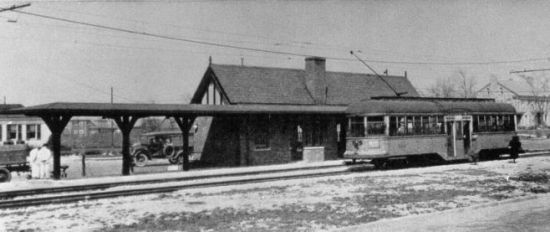
The Vans saw Shaker Square as a focal point and gateway to their suburb to the east, Shaker Heights. Integral to their vision of "Shaker Village" and the development of Shaker Square was the creation of a rapid transit (light rail) connection to downtown Cleveland. The Vans were at the peak of their power, owning or controlling most of what would become Shaker Heights, the Nickel Plate and other railroads and the Terminal Tower (now part of Tower City) which would open in 1930 as the tallest building between New York and Chicago. |
|
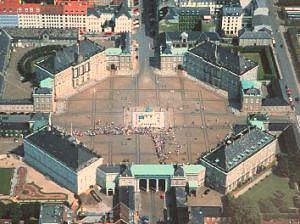
To accommodate automobile parking the design changed from a circle to an octagon. This plan suggested 18th-century European royal squares as a design source. Central pavilions flanked by lower wings can be seen in each quadrant. Shaker Square's style and detail are American Colonial - Georgian to conform with the vision for Shaker Heights. (More on the early years.) Amalienborg
Square in Copenhagen, |
 |
|
The Square, constructed from 1927 - 29, celebrated its 75th anniversary in November 2004. The Colony Theater was built in 1937. In the 1951 aerial view of Shaker Square, below, note the rapid transit turnaround loop in the center of the green. |
|
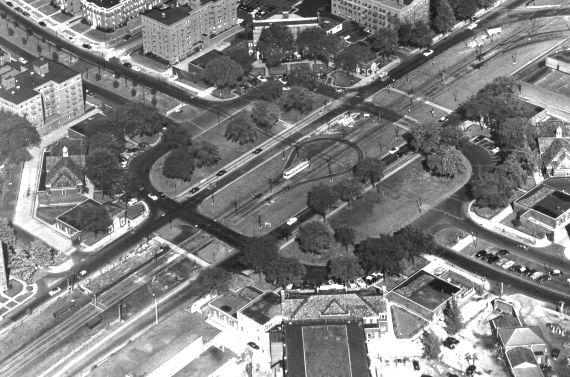 An aerial view of Shaker Square - 1951 |
|
|
Who owned
and owns Shaker Square? Today the answer is clear: it's The Coral Company that owns the four buildings and the land they are on, plus the public areas and more. Before them, but after the Van Sweringens, the ownership was complex. In July 2000 Karen Kurdziel, then a reporter for the Sun Press, wrote a carefully researched story (more) about the two young men who were the "visible guiding lights" in the Square's $24 million renovation and the corporations that really owned the Square. The owner before those two? Many (myself
included)
thought it was Larry Albert, but he may have been the manager for a group
of absent and silent owners. (If you can shed more light on this
subject, please
contact me.) |
|
|
Why is
Shaker Square in the Shaker Heights School District? |
|
|
To learn more about the history of Shaker Square |
|
|